Sub-Tier Supply Chain Visibility: Seeing Beyond Tier 1
Most disruption starts in the suppliers you can't see. This is what sub-tier supply chain visibility means, why seeing beyond Tier 1 is so hard, and a practical way to map the Tier 2 and Tier 3 dependencies that actually threaten you.


Sub-tier supply chain visibility is the ability to see past your direct suppliers into the suppliers underneath them, your Tier 2, Tier 3 and beyond, and understand where your real dependencies and risks sit. It's hard for one blunt reason: you have no contract with those companies. You buy from your Tier 1 suppliers, but they buy from theirs, and each layer down is a supplier you don't pay, can't audit, and often can't even name. That's the paradox of sub-tier visibility: the risk that matters most lives in the part of your network you control least.
For years this was treated as an unavoidable blind spot. It isn't anymore, and the gap between organisations that can see below Tier 1 and those that can't is becoming one of the clearest dividing lines in supply chain risk.
Why the risk hides below Tier 1
Most disruption doesn't start with the supplier you're looking at. It starts one, two or three tiers down, in a sub-component, a raw material, or a single factory that several of your Tier 1 suppliers quietly share. By the time it reaches you it looks like a Tier 1 problem, but the cause sat far deeper.
The numbers make the point. An estimated 85% of supply chain disruptions originate in the lower tiers, where visibility is weakest. Yet while around 95% of organisations can see their Tier 1 risks, only about 42% have any visibility into Tier 2 or beyond. Most companies, in other words, are managing a small, well-lit corner of their network and hoping the dark majority holds.
Why it's so hard to see
Three things make sub-tier visibility difficult. First, there's no contractual relationship: you can compel disclosure from a Tier 1 supplier, but not from their suppliers, and many treat their sources as commercially sensitive. Second, the data is fragmented and stale: what you can gather is often self-reported, incomplete and out of date the moment it's collected. Third, the network is dynamic: suppliers change their own sources constantly, so even an accurate map decays quickly. Visibility isn't a one-time data-collection exercise; it's a moving target.
How to map tier-2 and tier-3 suppliers you can't see
You'll never have perfect sub-tier data, so the goal isn't completeness, it's enough visibility to find the dependencies that matter. A workable approach has four moves.
Start with your critical Tier 1 suppliers and work down. You can't map everything, so begin with the suppliers whose failure would hurt most, and trace their sources for the components that matter. Depth where it counts beats breadth everywhere.
Ask, but corroborate. Supplier surveys and disclosures are a starting point, not the truth. Combine what suppliers tell you with external data, trade and shipping records, corporate ownership, financial and geographic signals, so you're not reliant on self-reporting alone.
Look for concentration, not just connections. The point of the map isn't a tidy chart of who supplies whom; it's spotting where several of your suppliers converge on the same sub-tier source, region or chokepoint. Shared dependencies are where a single failure cascades into what looked like diversified supply.
Keep it live. Because sources change, treat the map as something that updates, with triggers to re-check when a supplier, region or dependency shifts. A map you refresh is worth far more than a perfect snapshot you file away.
Turning visibility into decisions
A map on its own is just a picture. What makes sub-tier visibility valuable is what you do with it: knowing which hidden dependencies actually threaten you, and by how much. That means moving from 'here's who supplies our suppliers' to 'here's the value at risk if this sub-tier source fails, and how the disruption would propagate up to us.' Modelling that propagation, cause and effect through the network rather than a static list, is what turns a map into a ranked set of decisions you can act on and defend.
Seen this way, sub-tier visibility isn't a mapping project with an end date. It's the foundation for every other part of a risk programme, because you can't assess, score or mitigate a risk you can't see.
Sub-tier visibility is the hardest part of seeing your true exposure, and the most valuable. For how it fits into a complete approach, see our guide to supply chain risk management.
Questions this piece raises
What is sub-tier supply chain visibility?

Why is sub-tier visibility so hard to achieve?
How do you map tier-2 and tier-3 suppliers?
See Causal AI applied to your supply chain.
A structured, 45-minute session with a senior solutions architect.
Request a Demo
Related insights

How to Model a Supply Chain Disruption Before It Happens
You model a disruption before it happens by simulating it against a model of your network, then testing the response, where mistakes are free. A practical, step-by-step guide.
Geopolitical Supply Chain Risk: Modelling the Next Shock
Geopolitical events now hit supply chains constantly, and you carry exposure even if you never trade across a border. What geopolitical supply chain risk is, how it reaches your network, and how to model the next shock.
Supply Chain Visibility Software: What to Look For in 2026
Not all supply chain visibility is equal. A practical guide to choosing supply chain visibility software in 2026: the capabilities that actually matter, from sub-tier depth to turning what you see into decisions.
How to Build a Supply Chain Risk Management Framework
A supply chain risk management framework is what turns scattered risk activity into a repeatable capability. This is how to build one in six parts: ownership, risk tolerance, a standard process, a data foundation, decision-making, and continuous improvement.
Supply Chain Risk Assessment: A Step-by-Step Framework
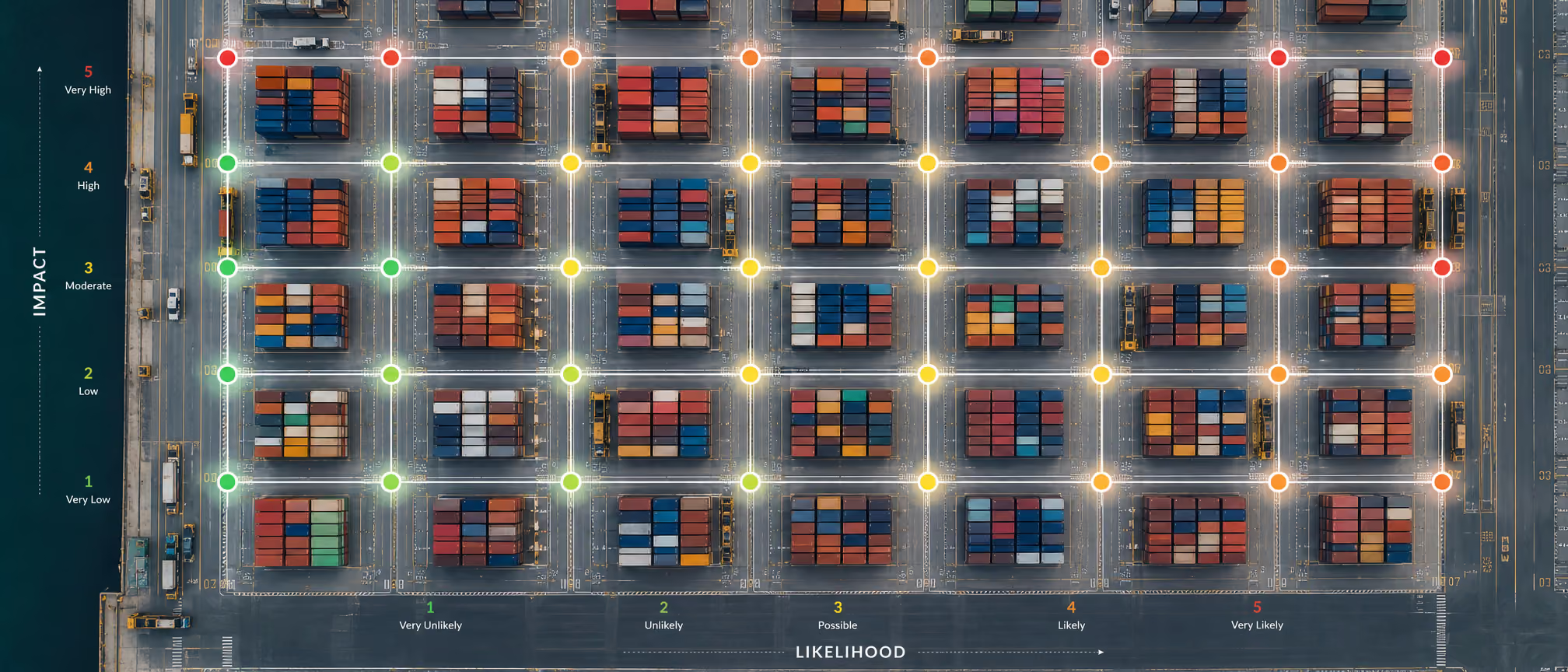
A supply chain risk assessment only drives decisions if it's built on a repeatable framework. This is the six-step method: map your network, identify and score risks, build a risk matrix, assign mitigation, and keep it current.
The 4 Types of Supply Chain Risk (and How to Assess Each)
Not all supply chain risk behaves the same way. This guide breaks risk into its four core types, supply, demand, operational and external, and shows you how to assess each one so you can see where your network is genuinely exposed.

