

You model a supply chain disruption before it happens by building a model of your network, introducing a shock into it, a supplier failure, a closed port, a tariff, a demand spike, and following how that shock propagates through the network to see what it would cost and what would contain it. Instead of waiting for a real disruption to reveal your weak points, you rehearse it on a model, where mistakes are free. This is a practical guide to doing that well.
Why model before, not after
The instinct is to deal with disruptions when they arrive. The problem is that a live disruption is the worst time to work out its full impact: information is incomplete, the clock is running, and every option costs more than it would have yesterday. Modelling moves that thinking earlier, to a moment when you have time, data and no pressure. And because disruption is now near-constant and overlapping rather than occasional, the payoff isn't a one-off exercise; it's an ongoing readiness for whatever combination arrives next.
How to model a disruption, step by step
1. Build a model of your network. You can only simulate a shock against a representation of how your network actually works: the suppliers, sites, routes and flows, and the dependencies between them, including the sub-tier sources beneath your direct suppliers. The quality of the model sets the ceiling on how useful the simulation can be.
2. Choose the disruption to simulate. Pick the shocks worth rehearsing, informed by your real exposures: a critical supplier failing, a lane or port closing, a tariff or sanction, a sudden demand swing. You're not trying to model everything, just the events that would actually hurt.
3. Propagate it through the network. This is the heart of it. Introduce the shock and follow it: which nodes are hit first, what depends on them, how the effect cascades into second and third-order impacts. A disruption rarely stays where it starts, and the propagation is usually where the real damage, and the surprises, live.
4. Quantify the impact. Translate the simulated shock into numbers you can act on: the value at risk, the volume or revenue affected, the time to recover. Quantifying impact is what lets you compare one scenario against another and prioritise.
5. Test the interventions. Now use the model for what-if: if we hold more stock here, qualify a second source there, or reroute this flow, how does the outcome change? This is where modelling earns its keep, letting you compare responses before committing budget to any of them.
6. Decide and pre-position. Turn the best response into a plan: the alternate source pre-qualified, the buffer in place, the decision already made. The point of modelling is to walk into the real event with the answer ready.
Why causal modelling matters here
A model is only as trustworthy as its what-ifs, and this is where the underlying method matters. A model built on correlation can replay what tended to happen before, but it can't reliably tell you what would happen if you intervened, because it doesn't represent cause and effect. Causal modelling represents the mechanisms of your network, so its answers to 'what if we did X' hold up, including for shocks with no precedent. When the whole point is to test interventions against novel events, modelling cause rather than correlation is what makes the exercise credible.
Modelling a disruption before it happens turns your response from improvisation into rehearsal. Build the network, simulate the shocks that matter, quantify the impact, and test the moves, so the real event finds you ready. For the wider discipline, see our guide to supply chain scenario planning, and for handling the event when it lands, managing supply chain disruption.
Questions this piece raises
How do you model a supply chain disruption before it happens?

What is supply chain disruption modelling?
What data do you need to model a supply chain disruption?
See Causal AI applied to your supply chain.
A structured, 45-minute session with a senior solutions architect.
Request a Demo
Related insights

Geopolitical Supply Chain Risk: Modelling the Next Shock
Geopolitical events now hit supply chains constantly, and you carry exposure even if you never trade across a border. What geopolitical supply chain risk is, how it reaches your network, and how to model the next shock.
Supply Chain Visibility Software: What to Look For in 2026
Not all supply chain visibility is equal. A practical guide to choosing supply chain visibility software in 2026: the capabilities that actually matter, from sub-tier depth to turning what you see into decisions.
How to Build a Supply Chain Risk Management Framework
A supply chain risk management framework is what turns scattered risk activity into a repeatable capability. This is how to build one in six parts: ownership, risk tolerance, a standard process, a data foundation, decision-making, and continuous improvement.
Sub-Tier Supply Chain Visibility: Seeing Beyond Tier 1
Most disruption starts in the suppliers you can't see. This is what sub-tier supply chain visibility means, why seeing beyond Tier 1 is so hard, and a practical way to map the Tier 2 and Tier 3 dependencies that actually threaten you.
Supply Chain Risk Assessment: A Step-by-Step Framework
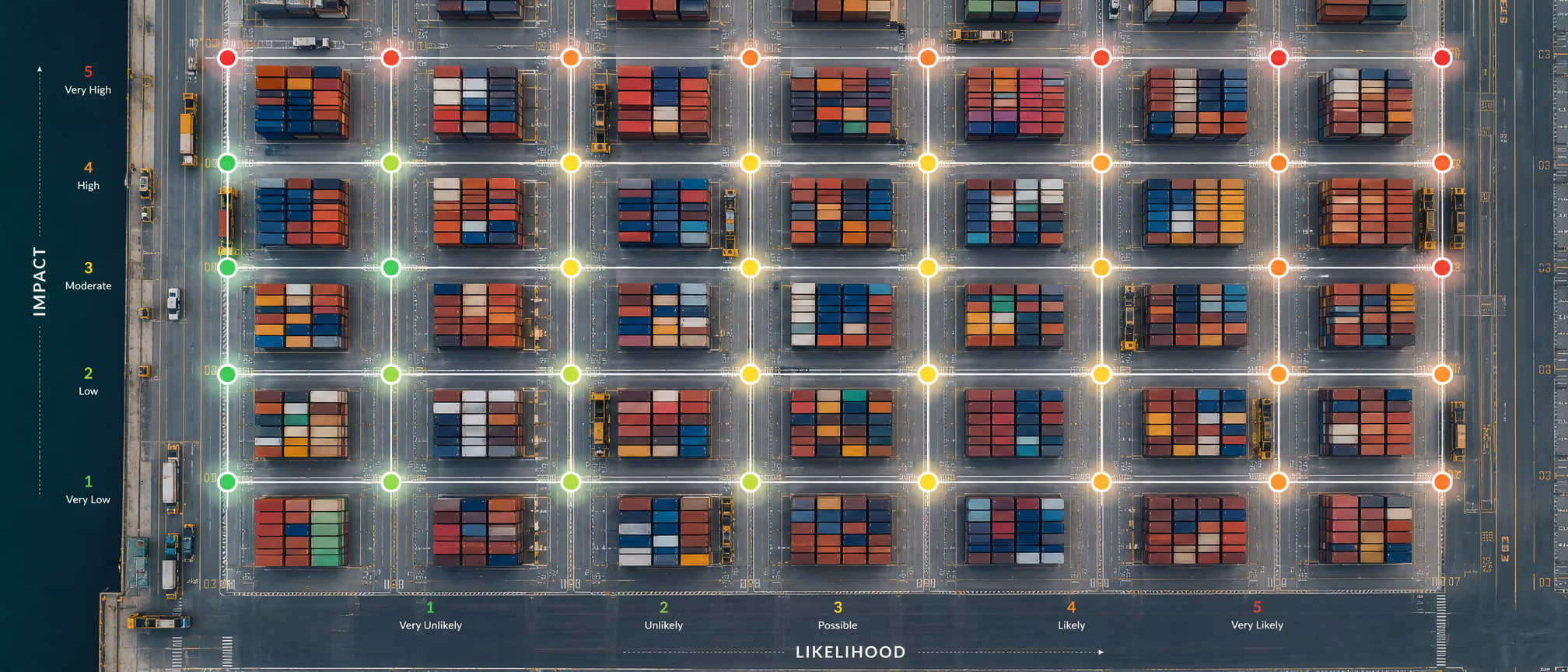
A supply chain risk assessment only drives decisions if it's built on a repeatable framework. This is the six-step method: map your network, identify and score risks, build a risk matrix, assign mitigation, and keep it current.
The 4 Types of Supply Chain Risk (and How to Assess Each)
Not all supply chain risk behaves the same way. This guide breaks risk into its four core types, supply, demand, operational and external, and shows you how to assess each one so you can see where your network is genuinely exposed.

