

Supply chain visibility software is the category of tools that show you what's happening across your supply network, from your direct suppliers down through the tiers beneath them, and out to the events that could disrupt them. The problem is that 'visibility' has become a label on almost everything, and the tools vary enormously in how deep they see, how current they are, and whether they help you do anything with what they show. This is a practical guide to what actually matters when you're choosing supply chain visibility software in 2026.
Why visibility is the foundation
Every part of supply chain risk management depends on visibility, because you can't assess, prioritise or mitigate a risk you can't see. That's why visibility software is often the first serious investment teams make. But visibility is a means, not an end: a beautiful map that doesn't change your decisions is an expensive screensaver. The best tools are judged not by how much they show, but by how much better they make your decisions.
What to look for
Depth beyond Tier 1. Most disruption originates below your direct suppliers, so the single most important question is how far down the tool can actually see. Look for genuine sub-tier or n-th tier mapping, not just a tidy view of the suppliers you already know.
Live, not a snapshot. Supplier health, geopolitics and demand move constantly, so visibility that's refreshed quarterly is out of date by the time you look. Look for continuously updated data, so the picture reflects now, not last quarter.
Breadth of signals. Real visibility combines your internal data with external signals, financial, geographic, geopolitical, event and news, so risk is surfaced from every direction rather than just from your own records.
From map to decision. This is where tools separate. A map tells you what your network looks like; you need software that helps you act, prioritising exposures by the value at risk behind them and, ideally, letting you model how a disruption would propagate and what to do about it. Visibility that ends at a dashboard leaves the hardest work to you.
Defensible, explainable output. Especially in regulated, government and defence contexts, the tool's risk scores and recommendations should come with their reasoning, so you can justify the decisions they inform.
Integration and data quality. The best analysis is useless on bad or disconnected data. Look at how the tool ingests, cleans and connects your data, and how well it fits the systems you already run.
What to be wary of
A few common shortfalls are worth naming. Tools that show only Tier 1 and call it visibility. Dashboards that generate alerts without prioritising them, creating fatigue rather than focus. And correlation-based analytics that can tell you something changed but not what it means for you or what to do about it. Each looks like visibility in a demo and falls short in a real disruption.
The shift in 2026
The direction of travel is clear: from static, Tier 1 dashboards toward deep, live, decision-oriented visibility. The tools worth investing in now are the ones that don't just show you the network, but help you reason about it, so visibility becomes the foundation for scenario planning and defensible action rather than an end in itself.
Choose for depth, currency, breadth and, above all, for whether the tool improves your decisions. For how visibility feeds into rehearsing disruptions, see our guide to supply chain scenario planning, and for the sub-tier depth that matters most, sub-tier supply chain visibility.
Questions this piece raises
What is supply chain visibility software?

What should you look for in supply chain visibility software?
What is end-to-end supply chain visibility?
See Causal AI applied to your supply chain.
A structured, 45-minute session with a senior solutions architect.
Request a Demo
Related insights

How to Model a Supply Chain Disruption Before It Happens
You model a disruption before it happens by simulating it against a model of your network, then testing the response, where mistakes are free. A practical, step-by-step guide.
Geopolitical Supply Chain Risk: Modelling the Next Shock
Geopolitical events now hit supply chains constantly, and you carry exposure even if you never trade across a border. What geopolitical supply chain risk is, how it reaches your network, and how to model the next shock.
How to Build a Supply Chain Risk Management Framework
A supply chain risk management framework is what turns scattered risk activity into a repeatable capability. This is how to build one in six parts: ownership, risk tolerance, a standard process, a data foundation, decision-making, and continuous improvement.
Sub-Tier Supply Chain Visibility: Seeing Beyond Tier 1
Most disruption starts in the suppliers you can't see. This is what sub-tier supply chain visibility means, why seeing beyond Tier 1 is so hard, and a practical way to map the Tier 2 and Tier 3 dependencies that actually threaten you.
Supply Chain Risk Assessment: A Step-by-Step Framework
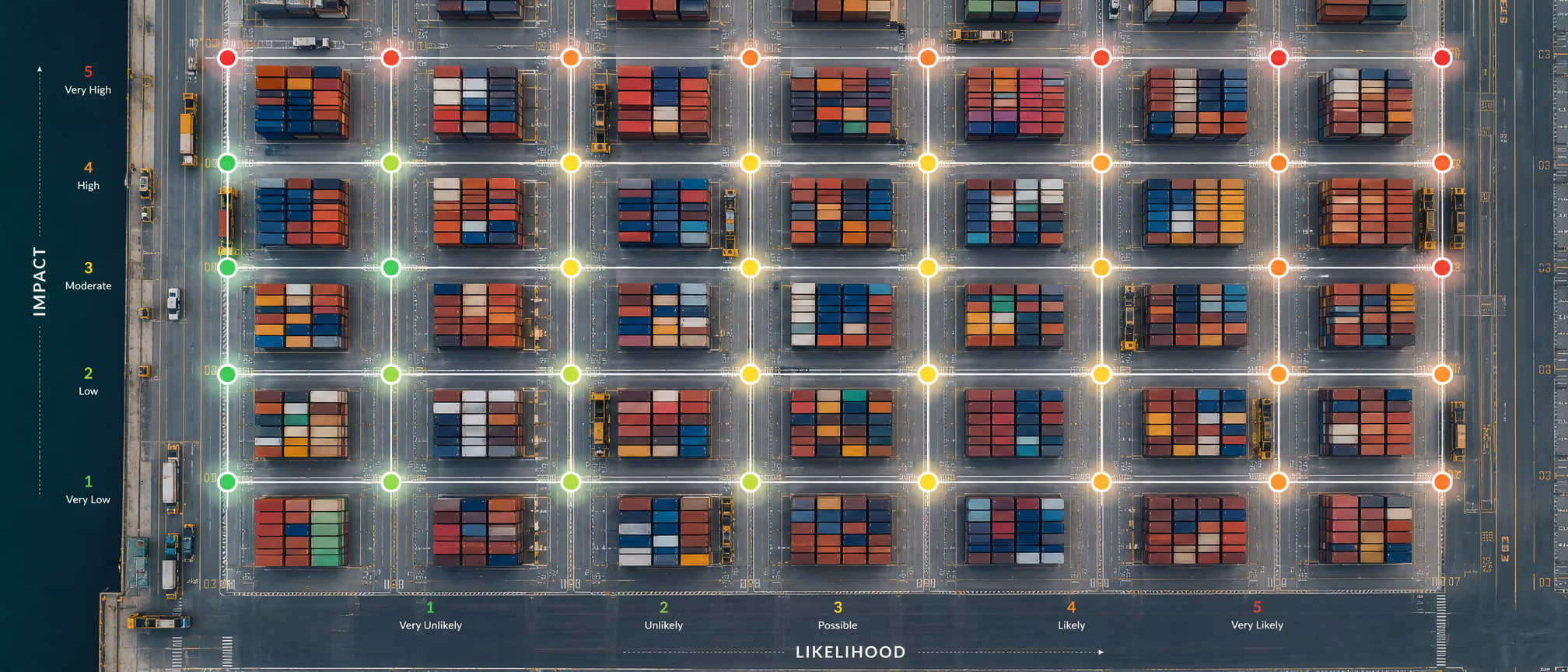
A supply chain risk assessment only drives decisions if it's built on a repeatable framework. This is the six-step method: map your network, identify and score risks, build a risk matrix, assign mitigation, and keep it current.
The 4 Types of Supply Chain Risk (and How to Assess Each)
Not all supply chain risk behaves the same way. This guide breaks risk into its four core types, supply, demand, operational and external, and shows you how to assess each one so you can see where your network is genuinely exposed.

