How to Build a Supply Chain Risk Management Framework
A supply chain risk management framework is what turns scattered risk activity into a repeatable capability. This is how to build one in six parts: ownership, risk tolerance, a standard process, a data foundation, decision-making, and continuous improvement.


A supply chain risk management framework is the operating system for how your organisation finds, assesses and acts on risk: the structure that turns ad hoc firefighting into a repeatable discipline. Building one isn't about producing a document. It's about putting six things in place: clear ownership, a defined risk tolerance, a single risk process, a data foundation you can trust, a way to act on what you find, and a habit of improving all of it over time. Get those six working together and risk management stops being a project and becomes a capability.
Plenty of organisations have pieces of this, a risk register here, a supplier audit there, but the pieces don't connect, so nothing compounds. A framework is what connects them. Here's how to build one.
1. Put someone in charge
A framework needs a clear owner and defined roles. Decide who owns supply chain risk at the leadership level, who does the day-to-day work, and who is accountable for acting when a risk materialises. Without ownership, a risk register is just a list nobody maintains. Be explicit about escalation too: what level of exposure triggers a decision, and whose decision it is. Governance sounds like the dull part, but it's what makes every other part actually happen.
2. Define your risk tolerance
Not every risk is worth acting on, and a framework that treats them all as equal drowns you in noise. Defining your risk tolerance, sometimes called risk appetite, sets the threshold between the exposure you're willing to carry and the exposure that demands action. Make it concrete: express tolerance in terms you can measure against, such as the maximum value at risk you'll accept on a single supplier, the level of single-source dependency you'll allow for a critical component, or the recovery time you're prepared to tolerate for a key flow. Those thresholds turn judgement into rules: when an exposure crosses the line it escalates automatically to the owner you named in step one, rather than waiting for someone to notice. Tolerance also has to reflect context, because a defence or government supply chain will carry far less tolerance for certain risks than a consumer-goods one. Set it deliberately, write it down, and revisit it as the business and its environment change.
3. Standardise one risk process
At the core of the framework is a single, repeatable loop: identify, assess, mitigate, monitor. Identify what could go wrong by working through the four types of supply chain risk. Assess and rank exposure using a consistent risk assessment framework. Decide a mitigation and an owner for each priority, then monitor so nothing drifts. The point of standardising is comparability: when every team runs the same process, risks from very different parts of the business can be weighed on the same terms.
4. Build the data and visibility foundation
A framework is only as good as the information feeding it. That means investing in visibility, and specifically in seeing past your direct suppliers into the sub-tier suppliers where most disruption begins. It also means keeping that data current, because supplier health, ownership and exposure all move. A framework built on a stale annual snapshot will always be managing yesterday's risk.
5. Connect risk to decisions
This is where most frameworks quietly fail: they produce reports nobody acts on. A framework earns its place only when it changes what you do. That means quantifying the value at risk on each exposure so you can prioritise by what's genuinely at stake, and making each recommendation defensible, so when you're asked why a risk was prioritised or a mitigation chosen, the reasoning is there. Modelling why a disruption would propagate, rather than just noting that risk is rising, is what lets a framework drive decisions you can stand behind in front of a board, an auditor or a regulator.
6. Make it continuous and improving
Finally, treat the framework as a living system, not a binder. Set a review cadence, learn from near-misses as much as from incidents, and raise the maturity of each component over time: better data, tighter process, faster response. The organisations that stay ahead of disruption aren't the ones with the most detailed framework on paper; they're the ones whose framework gets a little sharper every quarter.
Build these six parts so they reinforce each other and you have more than a process; you have a capability that compounds. For how the whole discipline fits together, see our guide to supply chain risk management.
Questions this piece raises
What are the components of a supply chain risk management framework?

What is the difference between a risk management framework and a risk assessment?
How do you make sure a risk framework is actually used?
What is risk tolerance in supply chain risk management?
See Causal AI applied to your supply chain.
A structured, 45-minute session with a senior solutions architect.
Request a Demo
Related insights

How to Model a Supply Chain Disruption Before It Happens
You model a disruption before it happens by simulating it against a model of your network, then testing the response, where mistakes are free. A practical, step-by-step guide.
Geopolitical Supply Chain Risk: Modelling the Next Shock
Geopolitical events now hit supply chains constantly, and you carry exposure even if you never trade across a border. What geopolitical supply chain risk is, how it reaches your network, and how to model the next shock.
Supply Chain Visibility Software: What to Look For in 2026
Not all supply chain visibility is equal. A practical guide to choosing supply chain visibility software in 2026: the capabilities that actually matter, from sub-tier depth to turning what you see into decisions.
Sub-Tier Supply Chain Visibility: Seeing Beyond Tier 1
Most disruption starts in the suppliers you can't see. This is what sub-tier supply chain visibility means, why seeing beyond Tier 1 is so hard, and a practical way to map the Tier 2 and Tier 3 dependencies that actually threaten you.
Supply Chain Risk Assessment: A Step-by-Step Framework
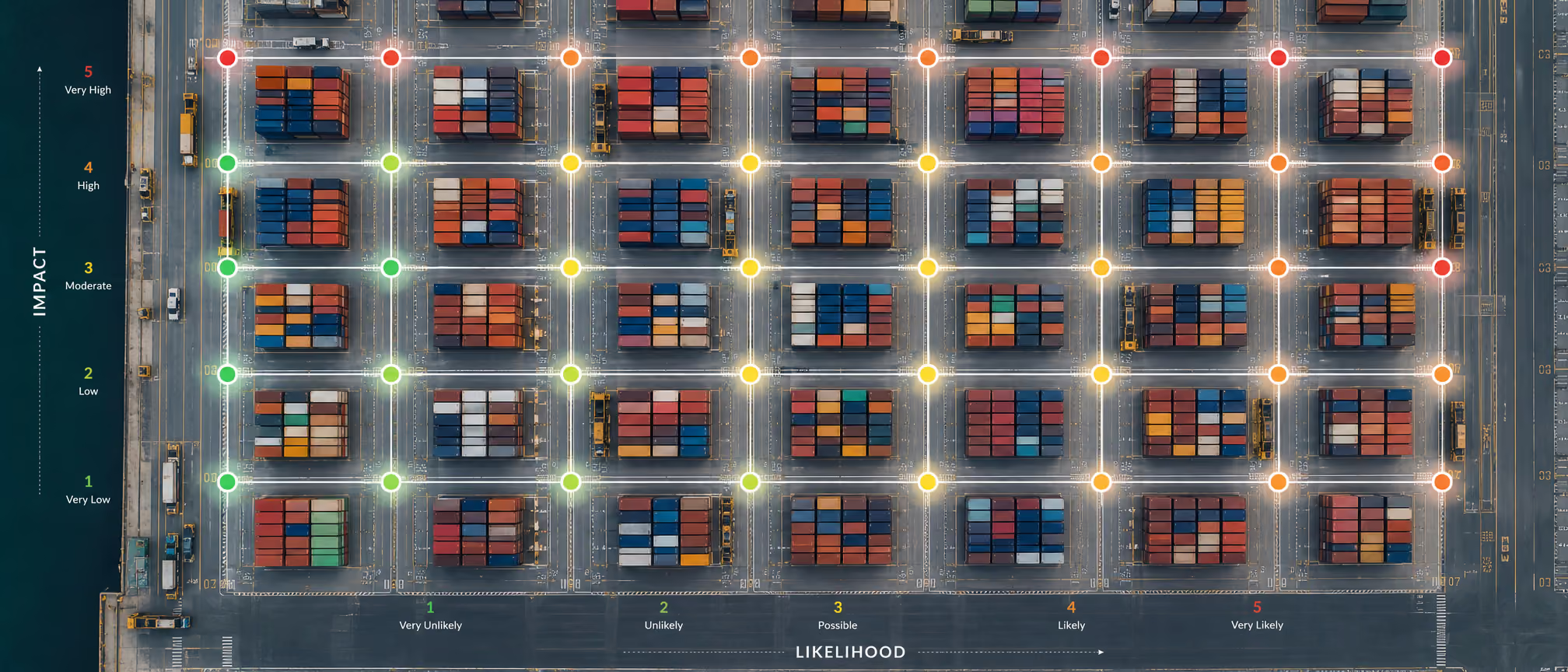
A supply chain risk assessment only drives decisions if it's built on a repeatable framework. This is the six-step method: map your network, identify and score risks, build a risk matrix, assign mitigation, and keep it current.
The 4 Types of Supply Chain Risk (and How to Assess Each)
Not all supply chain risk behaves the same way. This guide breaks risk into its four core types, supply, demand, operational and external, and shows you how to assess each one so you can see where your network is genuinely exposed.

